The Future of Bioinformatics
A satirical look at the future bioinformatician managing hundreds of AI agents instead of analyzing data.
Future bioinformaticians be like:
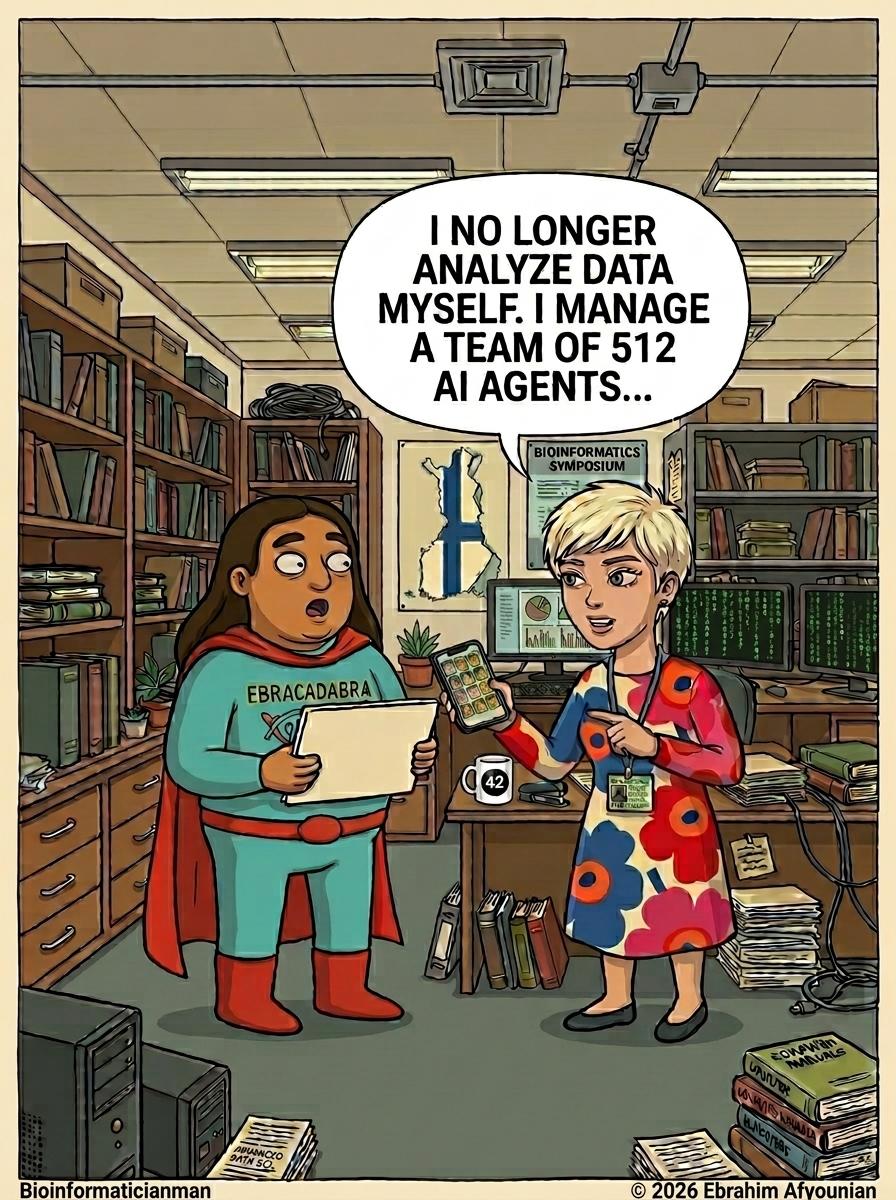
“I no longer analyze data myself. I manage a team of 512 AI agents from the latest iPhone Pro Max while waiting for my coconut cloud matcha with oat milk at a carbon-neutral matcha bar whose supply chain is more transparent than my analysis pipeline.”
Our lab has developed scSpatial-SPECTRUM-3D-seq, a truly single-cell, subcellular-resolution, spatial, ultra-deep, hyper-multi-omic assay that simultaneously measures:
- 🧬 Whole-genome sequence
- 🧬 Somatic mutations and copy-number alterations
- 🧬 Chromatin accessibility
- 🧬 DNA methylation
- 🧬 RNA expression
- 🧬 Multiplex transcription-factor binding
- 🧬 Histone modifications
- 🧬 Chromatin conformation
- 🔗 Every possible enhancer-promoter interaction
- 🏘️ Whether they live in the same topologically associating domain
- 🧬 Protein abundance
- 🧬 Protein phosphorylation
- 🗺️ And, crucially, where all of this happened
Naturally, every molecular layer has its own autonomous department.
The Genome Agent calls mutations, structural variants and copy-number alterations.
The Epigenome Agents identify differential accessibility, methylation, transcription-factor occupancy and histone modifications.
The Transcriptome Agent performs differential expression, isoform analysis, and fusion detection.
The Proteome Agents quantify differential protein abundance and phosphorylation.
The Statistical Power Agent confirms that 14 patients are sufficient because each patient contributes several million independent cells.
The Benjamini-Hochberg Agent corrects for multiple testing separately within every modality, cell type, spatial neighbourhood, treatment group and direction of effect.
When nothing remains significant, the Hypothesis-Family Agent reorganizes the tests into more biologically meaningful families.
The Chromatin-Conformation Agent identifies loops, compartments and TADs.
An Enhancer-Promoter Agent connects every accessible region to the nearest interesting gene.
A TAD Compliance Agent checks whether each enhancer-promoter interaction stays within its legally permitted regulatory neighbourhood. If a structural variant creates a neo-TAD or enables enhancer hijacking, the Boundary Violation Agent labels it “potentially novel.”
Differential analysis is only the beginning
For every candidate regulatory interaction, a swarm of specialized Jev Agents makes millions of tiny decisions:
- Is the regulatory element accessible?
- Is it differentially methylated?
- Does it contain the appropriate motif?
- Is the transcription factor actually bound there?
- Is its binding supported by multiplex ChIP-seq?
- Is the enhancer connected to the target gene?
- Does target-gene expression change in the expected direction?
- Is the transcription factor expressed, translated and appropriately phosphorylated?
- Has a mutation disrupted or created its binding site?
- Is the apparent expression change simply caused by copy-number gain or loss?
- And does the entire relationship remain valid within the same cell type and spatial neighbourhood?
Whenever the evidence becomes contradictory, Jev escalates the interaction to Opus with maximum reasoning effort.
The Gene Regulatory Network Agent then integrates the genome, epigenome, transcriptome, proteome and phosphoproteome to reconstruct a spatially resolved, cell-type-specific, mutation-aware and dosage-aware regulatory network.
The Network Validation Agent performs perturbation analysis, stability testing, cross-validation and replication across cohorts.
The Causal Inference Agent quietly changes every edge from correlation to causation.
An Orchestrator Agent coordinates everything through Model Context Protocol, an unnecessarily large tool stack and one spreadsheet called:
final_results_v42_REALLY_FINAL_USE_THIS_ONE.xlsx
The Integration Agent projects every modality into a unified latent space that nobody can interpret, but which separates the treatment groups beautifully after changing the random seed.
The Visualization Agent generates 46 versions of the same network diagram.
The UMAP Agent produces a UMAP, regardless of whether anybody requested one.
From methods to “transformative” impact
The Methods Agent writes:
“Briefly, all molecular layers were jointly analyzed using an agentic, context-aware, mutation-aware, dosage-aware and fully reproducible framework with default parameters.”
The Novelty Agent confirms that the approach is unprecedented.
The Atlas Agent declares that we have generated the first:
“Comprehensive single-cell spatial multi-omic regulatory atlas of the disease.”
The Discussion Agent concludes that the study reveals:
- a previously unknown regulatory landscape
- extensive epigenetic and transcriptional reprogramming
- novel mutation-dependent transcription-factor circuitry
- spatially organized disease mechanisms
- unexpected cellular heterogeneity
- and potentially transformative clinical implications
The Translational Impact Agent converts the regulatory network into a ranked list of target-effector protein pairs for induced-proximity medicines.
The top candidate is immediately described as potentially first-in-class.
However, further experimental validation is required.
Reviewer #2 enters the workflow
The Submission Agent selects a high-impact journal, writes a carefully tailored cover letter explaining why the manuscript is timely, unprecedented and ideally suited to the journal, and uploads the manuscript.
Three weeks later, the Reviewer Agent receives Reviewer #2’s feedback:
“The authors should validate the network in three independent cohorts, demonstrate direct enhancer-promoter interactions, perform mechanistic perturbation experiments and provide deeper integration of all modalities.”
The Revision Manager Agent immediately spawns:
- an Independent Cohort Agent
- a CRISPR Perturbation Agent
- an Enhancer-Promoter Validation Agent
- a Pathway Enrichment Agent
- a Cell-Cell Communication Agent
- a Survival Analysis Agent
- a Trajectory Agent that arranges every cell along pseudotime until the desired biological story emerges
- a Digital Twin Agent
- a Causal Network Agent
- and twelve additional UMAP Agents
The Additional Analysis Agent discovers that the manuscript requires four new supplementary figures.
The Supplementary Materials Agent turns them into thirty-seven supplementary figures.
The Response-to-Reviewers Agent writes:
“We thank the reviewer for this insightful suggestion.”
The Senior Corresponding Agent approves everything.
The human bioinformatician’s only remaining scientific contribution is asking:
“Wait, was this hg19 or hg38?”
I no longer do bioinformatics. I manage 512 bioinformaticians who do not exist.